Friday, July 31, 2009
函館!
I have arrived safely in Hakodate! I'd better be getting to bed, because I plan to wake up early in the morning to go to an onsen and then take the cable car up Hakodate Mountain for a morning view of the city. More when I get a chance!

Thursday, July 30, 2009
北海道へ!
I am sitting in the computer classroom at IUC, where I am all but completely done with the Summer Program. I cannot believe how quickly it has gone by! Wednesday was my final exam. Then, yesterday was the 研究発表会 (short research presentations). I did a presentation on high-speed rail in Japan and the U.S., which was a nice opportunity for this aspiring railfan to research a topic of interest in Japanese and prepare a PowerPoint. I had been worried that I wouldn't get much writing practice out of this program, but the presentation turned out to be a good way to incorporate the Japanese I had learned in other parts of the course into my writing skills. I definitely could tell that I have made an improvement over these six weeks as I prepared and revised the draft.
I'd better run to the graduation ceremony in the next room now. I had planned to tell you about the trip, but most likely I'll next post from Hakodate, Hokkaido, where I'm staying tonight. In short, I'm really excited!
I'd better run to the graduation ceremony in the next room now. I had planned to tell you about the trip, but most likely I'll next post from Hakodate, Hokkaido, where I'm staying tonight. In short, I'm really excited!
Tuesday, July 28, 2009
靖國神社
Before I get caught up with matters pertaining to my last week of classes and my upcoming trip, I should fill you in on Friday's 校外学習 (field trip).
We were given a choice of four different sights in Tokyo to visit after Friday's classes. I chose Yasukuni Jinja (whose name in kanji is the title of this post). Check out the link to the Wikipedia article if you need background. Essentially, it's a shrine dedicated to the spirits of Japanese who died fighting on behalf of the Emperor that has been a source of controversy for quite some time. The controversy arises from the fact that the shrine and its museum never make any mention of anything that could possibly paint Japan in a less-than-positive light at any point in its history. Having visited the museum, I can see why people are upset by it. Honestly, though, other than the fact that I was aware of some pretty significant historical negligence, it felt more like a normal museum than I expected it to feel. By this I mean mainly that the other people visiting the museum seemed like normal Japanese quietly looking around. I'm still thinking it all over.
 The shrine itself. That symbol printed four times on the banner is the Imperial Seal of Japan.
We were given a choice of four different sights in Tokyo to visit after Friday's classes. I chose Yasukuni Jinja (whose name in kanji is the title of this post). Check out the link to the Wikipedia article if you need background. Essentially, it's a shrine dedicated to the spirits of Japanese who died fighting on behalf of the Emperor that has been a source of controversy for quite some time. The controversy arises from the fact that the shrine and its museum never make any mention of anything that could possibly paint Japan in a less-than-positive light at any point in its history. Having visited the museum, I can see why people are upset by it. Honestly, though, other than the fact that I was aware of some pretty significant historical negligence, it felt more like a normal museum than I expected it to feel. By this I mean mainly that the other people visiting the museum seemed like normal Japanese quietly looking around. I'm still thinking it all over.
 The shrine itself. That symbol printed four times on the banner is the Imperial Seal of Japan.
Unfortunately, I wasn't able to take many pictures there, because past a certain point very early on in the museum, photography was prohibited. Thus, the most interesting photos that the day produced have more to do with modern Japan than traditional culture. I had been meaning for some time to get a good photo of an Engrish sign or two. Enjoy:
 I saw this as I was entering the museum ...
 ... and this on the way out.
 I saw this as I was entering the museum ...
 ... and this on the way out.
The latter is particularly interesting to me, because the error here results in a markedly un-Japanese effect. See my earlier post on the park sign about dog droppings for more details, but essentially, the extra period seems to impart an abruptness and lack of concern for the addressee's opinion that just won't do in Japanese in any situation that is not completely casual. In contrast, the Japanese on the sign is written in typically polite, humble style. Interesting.
Tomorrow is my final exam (already!), and I'll have more on that and next week's plans then. Now to study all that vocab ...
Tomorrow is my final exam (already!), and I'll have more on that and next week's plans then. Now to study all that vocab ...
Monday, July 27, 2009
富士山
Big news: I can now count myself among the millions and millions of people who have been to Japan's highest mountain, none other than Fuji-san itself!
Last weekend, I stayed in at my second cousins' in Ninomiya on Saturday night. We woke up at 6:30 on Sunday morning so as to try to beat the rush and the clouds. Unfortunately, we avoided neither completely. The traffic on the two-lane roads leading to and up the mountain was pretty bad, but we did make it to 五号目 (the fifth viewing point). Most of the clouds cleared up by the time we reached the mountain, but a single snail-shaped cloud around the summit would not budge for the entire day. I hear that's not atypical. Oh, well! Take a look:

 This is the "melon bread" to which I was treated as we were leaving. Yes, the Japanese eat watermelon-flavored bread. In this case, in the shape of a volcano. It was pretty tasty!
 This was taken outside the restaurant where we had soba after we descended the mountain. I forgot the name of the lake in the foreground, unfortunately.
 This was actually taken yesterday. It was the first time that Fuji-san was visible from the park in my neighborhood (a few minutes' walk from my relatives' house). My ojisan suspected that it would finally appear, and he was right! As you can see, though, the cloud around the summit would not leave.
I can see why Fuji-san has such a sacred aura around it for the Japanese, although in all honesty, I need to come back in winter to really appreciate it. Perfect, clear visibility basically never happens for the entire summer. Maybe I'll catch a glimpse of the top without a cloud cover before I leave!
Off to start homework now, but more soon on the last week of classes and my travel plans for next week!
Last weekend, I stayed in at my second cousins' in Ninomiya on Saturday night. We woke up at 6:30 on Sunday morning so as to try to beat the rush and the clouds. Unfortunately, we avoided neither completely. The traffic on the two-lane roads leading to and up the mountain was pretty bad, but we did make it to 五号目 (the fifth viewing point). Most of the clouds cleared up by the time we reached the mountain, but a single snail-shaped cloud around the summit would not budge for the entire day. I hear that's not atypical. Oh, well! Take a look:

 This is the "melon bread" to which I was treated as we were leaving. Yes, the Japanese eat watermelon-flavored bread. In this case, in the shape of a volcano. It was pretty tasty!
 This was taken outside the restaurant where we had soba after we descended the mountain. I forgot the name of the lake in the foreground, unfortunately.
 This was actually taken yesterday. It was the first time that Fuji-san was visible from the park in my neighborhood (a few minutes' walk from my relatives' house). My ojisan suspected that it would finally appear, and he was right! As you can see, though, the cloud around the summit would not leave.
I can see why Fuji-san has such a sacred aura around it for the Japanese, although in all honesty, I need to come back in winter to really appreciate it. Perfect, clear visibility basically never happens for the entire summer. Maybe I'll catch a glimpse of the top without a cloud cover before I leave!
Off to start homework now, but more soon on the last week of classes and my travel plans for next week!
Thursday, July 16, 2009
東京タワー、スピーチ
The fourth of six weeks of classes is almost over. Unbelievable!
Anyway, I realized that I forgot to tell you about the end of my excursion to Tokyo last Saturday. After the Yale Club of Japan BBQ, I thought I would go to 麻布十番温泉 (Azabu-Juban Onsen), because it was walking distance from the barbecue and, according to my Lonely Planet, Japan's "Best Inner-City Onsen" (I think they meant "urban" without the connotations of "inner-city," but you get the idea). Unfortunately, it turns out that the place closed down in March of 2008 (at least according to Wikipedia). How disappointing!
The walk to Azabu-Juban was certainly not a waste, though. I just pulled up out my Lonely Planet map of the area and figured I would see what was close. Turns out 東京タワー (Tokyo Tower) was also within walking distance, so I went there.

I bought a ticket to go up to the Main Observatory, and that was a great decision. It was absolutely mesmerizing up there. I spent more than an hour walking around and just sitting. I also got a delicious ミルクプリンチョコサンディー (that katakana is pronounced miruku-purin choko sandeii ... see if you can guess what it means!). Unfortunately, it was a bit difficult to take pictures through the glass in the dark, but you might get the general idea of how awesome the 360-degree view of the metropolis was from this:

 Yes, those are my feet. No, I am not about to die. I am standing on one of the windows aptly labeled "Look Down."
Pretty neat, don't you think? It's tough to convey how mesmerizing it was to be up there ...
The other order of business for this post is, of course, スピーチ (speech). I realized that I haven't written much about my actual classes, which is a shame, so I figured I would share a particular exciting moment from this week. In my class at IUC, every day one of the seven students is required to give a speech; there's a rotating schedule. Today was my day to give a speech, I think for the third time, and this time, I chose a topic that has been of great interest to me since a Yale friend sent me a link to this New York Times article last month. The topic of the speech I gave today was アイビールック、またはアイビースタイル ("Ivy Look" or "Ivy Style"). Apparently, since about the early 1960's, there has been a consistent segment of the Japanese public that is quite taken with the idea of dressing preppy. If you know me, you can imagine how delighted I was to learn this. Originally (perhaps even today), this style of wardrobe was inextricably associated with the Ivy League in the Japanese mind. Even better, right? So anyway, I wrote a speech about this phenomenon and delivered it to my classmates today. Definitely one of the most useful and personally relevant things I've done with my Japanese since I started. For some more background, here are the Japanese links I showed my classmates today:
This is undoubtedly one of the greatest things about modern Japanese culture.
On the note of "Ivy Style," I'll close with this, which I should have included in my last post, since it was taken at the barbecue on Saturday:
 神様のため、国のため、イェールのため
"For God, For Country, and For Yale"

I bought a ticket to go up to the Main Observatory, and that was a great decision. It was absolutely mesmerizing up there. I spent more than an hour walking around and just sitting. I also got a delicious ミルクプリンチョコサンディー (that katakana is pronounced miruku-purin choko sandeii ... see if you can guess what it means!). Unfortunately, it was a bit difficult to take pictures through the glass in the dark, but you might get the general idea of how awesome the 360-degree view of the metropolis was from this:

 Yes, those are my feet. No, I am not about to die. I am standing on one of the windows aptly labeled "Look Down."
The other order of business for this post is, of course, スピーチ (speech). I realized that I haven't written much about my actual classes, which is a shame, so I figured I would share a particular exciting moment from this week. In my class at IUC, every day one of the seven students is required to give a speech; there's a rotating schedule. Today was my day to give a speech, I think for the third time, and this time, I chose a topic that has been of great interest to me since a Yale friend sent me a link to this New York Times article last month. The topic of the speech I gave today was アイビールック、またはアイビースタイル ("Ivy Look" or "Ivy Style"). Apparently, since about the early 1960's, there has been a consistent segment of the Japanese public that is quite taken with the idea of dressing preppy. If you know me, you can imagine how delighted I was to learn this. Originally (perhaps even today), this style of wardrobe was inextricably associated with the Ivy League in the Japanese mind. Even better, right? So anyway, I wrote a speech about this phenomenon and delivered it to my classmates today. Definitely one of the most useful and personally relevant things I've done with my Japanese since I started. For some more background, here are the Japanese links I showed my classmates today:
- A magazine cover from last year
- A post on a Japanese style blog
- Van Jacket
- A diagram from a Japanese anthropology textbook*


This is undoubtedly one of the greatest things about modern Japanese culture.
On the note of "Ivy Style," I'll close with this, which I should have included in my last post, since it was taken at the barbecue on Saturday:
 神様のため、国のため、イェールのため
"For God, For Country, and For Yale"
Thirteen time zones away from dear old New Haven, the words ring no less true.
Sunday, July 12, 2009
外国人墓地、渋谷、中間試験、六本木
I'll try to keep this post quick because I don't want to start my fourth week of classes off any more tired than I need to be, so let me pick up where I left off in Friday's post, which was describing my day last Sunday (5th July).
I forgot to mention that while I was in Yamate, I went to the Yokohama Foreign Cemetery (横浜外国人墓地), which was pretty interesting and actually quite relaxing to walk through, since it is so peaceful compared to the places in which I spend most of my time. There were all sorts of different graves and some pretty notable people in the history of Japan buried there.
On Wednesday, I went up to Tokyo for my first real time. I say "real" because while the kabuki production at the National Theatre was a great experience, I only saw about three blocks of Tokyo then (we were on the subway or train the rest of the way there). The reason for the trip up on Wednesday was a dinner at a restaurant in Shibuya (渋谷) graciously organized by a member of the Yale Japanese faculty visiting Tokyo. There were a bunch of Yale students there. I knew some of them already from Japanese class back in New Haven, and I met some new ones. The students at the dinner Wednesday were mostly doing Light Fellowships at the Sun Academy Nihongo Center in Tokyo. I'm glad I went, because it hadn't occurred to me how comparatively little I get out here until I talked to them. They all live within the same block, so I gather that they often have the opportunity to venture out into Tokyo with each other to hang out. While I have a great living situation, the very thing that makes it so great (living with relatives in a real Japanese family and experiencing home life) is what makes me farther away from other students. Hopefully, I'll get up to Tokyo a couple more times and see the Elis who are there.
On that note, I actually went up to Tokyo again on Saturday, this time to Roppongi (六本木) for a Yale Club of Japan (warning: website mysteriously outdated) barbecue. The barbecue was at the U.S. Embassy Compound, which was pretty cool to see. There were 70-some Yale people and 40-some Dartmouth people (the event was co-sponsored with the Dartmouth Club of Japan) there. Kudos to the woman in Yale's Office of International Affairs who sponsored all the current undergraduates so that we wouldn't have to fork over precious yen for the barbecue!
You may have noticed that I skipped 中間試験. Have no fear. Well, maybe you should, because the kanji mean "midterm exam," which I took on Friday. I studied a lot, so I can only hope I did well. I think I did well, but it's tough to say since we hadn't really had any graded assignments in a traditional sense, so I don't have a bar relative to which to gauge my performance. In any event, I'll find out soon. Quite soon, actually, since it's getting late and my fatigue is about to reach headache level. I think that's my cue to sign off. More in a couple of days!
Friday, July 10, 2009
言葉!山手
It's Friday night, and I'm tired out from another long week, but a post seems rather overdue! There's one update I've been meaning to blog briefly for a while but keep forgetting. That's the 言葉 (kotoba) you see in the title. 言葉 means "word," but in this case it's the name of my new 電子辞書 (electronic dictionary), which is in the form of another iPod touch application. Kotoba! is completely free, and for this reason, among others, I give it a 10 out of 10. (It freezes every once in a while but is always back up running within 20 seconds, and it's not often enough to be a significant bother anyway.) The great thing about this is that the dictionary files are loaded into your iPod, so I no longer have to waste battery life (which WiFi drains comparatively quickly), bandwidth, and page loading time when I want to look up a word I hear in class, which happens quite a lot. I keep my iPod out on the desk in the classroom next to me at all times and rely heavily on Kotoba! then, on the street, at home with the relatives, anywhere ... in short, it's great. I highly recommend it to any Japanese speaker.
Now, to the past week's sights:
On Sunday, I went to 山手 (Yamate), a neighborhood of Yokohama that has historically housed a great number of 外国人 (foreigners). Most of the buildings there looked like there were plucked right out of Europe. I took a bunch of pictures of the park, but this one is the most interesting:

You might be able to guess the general meaning of this sign even if you can't read it. It asks dog owners not to let their dogs off a leash and to take care of anything they leave behind (you know what I mean). If you consider the grammar of this sign, I think you'll agree that this is both hilarious and culturally significant. An excessively literal translation of the second bullet point reads "as for dog droppings, let's owners always take it home." You really can't render a literal translation of the grammar of this sentence without sounding awkward, because the Japanese is designed to adhere to standards of politeness that we in the Anglosphere simply lack. The form of the verb "to take home" is volitional, meaning that it's equivalent to the English "let's take home." However, the subject of the verb is "dog owners," and what creates the problem for English speakers is that the imagined speaker of this sign (the embodiment of the park authorities or what have you) does not have a dog. If we analyze the grammar of the sentence on English terms, it seems downright odd, because the subject could not actually participate in the "let's" invitation.
In reality, of course, the sentence makes perfect sense; one just has to avoid analyzing a language as different from English as Japanese is on English terms. This sentence is an example of the Japanese tendency to state commands to specific groups of people as if they are something we all want to (and, what is more, can) obey. In general, the cultural mindset of the Japanese highly values politeness and group connections, as you may have read elsewhere. These emphases are reflected in countless Japanese constructions and forms of syntax, and both are seen here. The idea is that it is more polite to write the above than "please pick up after your dog" or "dogs must be kept on a leash." Further, rather than separating the rule-giver and supposed obeyer in the situation, the sentence creates community between them; another awkward but somewhat correspondent way to translate the idea behind the sentence would be "let's bring about a situation in which owners always take their dogs' droppings home." I've read other examples of this type of public notice in one of my JSL textbooks at Yale, but I forgot which chapter it was, so hopefully you get the general idea from this one. Pretty interesting, huh? Of course, language is always a window into culture, but I love the moments where I realize consciously that I've become able to see something specific from both sociolinguistic sides.
Well, I've gone on another grammar rant again--apologies. Anyway, the reason I was in Yamate was to go to Yokohama Christ Church, the English-speaking congregation of Yokohama. Christ Church shares the same building with 山手聖公会 (Yamate Sei Ko Kai), and on the first Sunday of every month, the two congregations have a joint bilingual service. This Sunday happened to be such a Sunday, which was pretty cool. The sermon was preached in English by an Englishman (any sermon is better in an English accent, of course), and the liturgy was in Japanese. The English priest had printed out a translation of his sermon into Japanese, which the Japanese congregation read while he preached. The bulletin was side-by-side English and Japanese, so it was pretty easy to follow everything.
I was going to write about a few more of the past week's events, but I've gotten carried away and more tired, so I'm going to call it a day for blogging. I'll be back tomorrow with the rest of what I was going to share.
Monday, July 6, 2009
歌舞伎、平塚、七夕、鎌倉
The third week of classes has begun, and the second week ended with a few notable activities.
On Friday, the IUC field trip was to the 国立劇所 (the National Theatre of Japan) in Tokyo. We took a JR train from Minato-Mirai Station, conveniently located in the basement of Queen's Square, up to Shibuya and then took the subway to Hanzoomon, the neighborhood in which the theatre is located. We went to see a presentation of 歌舞伎 (kabuki, a form of theatre native to Japan). Instead of a whole kabuki play, which might have been a bit long, this was a presentation designed for educational purposes. There were multiple large groups of Japanese schoolchildren in the audience, although there were some adults as well. Actually, Friday was the first time since arriving here that I saw traditional Japanese clothes being worn out and about. I've noticed that a significant majority of Japanese people wearing these clothes are women and girls (and the Japanese only wear them for special and particularly Japanese occasions). Interesting. Anyway, I didn't think of the possibility of turning my flash off during the kabuki production, so I only snapped pictures of the curtain, which was pretty beautiful itself:

I don't think you can see it in this shot, but somewhere on the corner of one of these curtains was a gold "TOYOTA" emblem. Pretty amusing, don't you think?
The presentation included a scene from 矢の根 (Ya no Ne or "The Arrowhead") and then the famous dance 藤娘 (Fuji Musume or "The Wisteria Maiden"). Most everyone's favorite part of the former was the horse. Goro, the main character of 矢の根, steals a horse from a farmer passing by so that he can go ride off to save his brother. This "horse" was played by two people in a hilarious costume. One actor's legs made the hind legs, and the other actor's legs were the front legs. They timed their walking perfectly and even managed to manipulate the head to show some emotion. I wish I had video. 藤娘 was performed, as is traditional, by an onnagata, a male kabuki actor who specializes in female roles. His makeup and costume were almost unbelievably elaborate. Apparently, 藤娘 is one of the hardest dances in the onnagata repertoire, and I could see why.
After kabuki, I had my first experience with figuring out 乗り換え (norikae, a transfer between different forms of public transportation) on my own. This was simultaneously exciting and harrowing. Anyway, after a Tokyo Metro subway ride and two different JR trains, I ended up at my destination, 平塚 (Hiratsuka). I went there to see the decorations for the 七夕 (Tanabata) festival. The train station there was filled with cops. I didn't realize that this was just because they were expecting crowds, so I was a bit unnerved at first. These should give you an idea of what it was like:


On Saturday, I went to 鎌倉 (Kamakura) with my obasan and ojisan. Kamakura, as I'm sure you already know from reading the linked Wikipedia article, was arguably the capital of Japan from the late 12th to the early 14th century. Anyway, we walked through two Buddhist temples (Engaku-ji and Meigetsu-in) and one Shinto shrine before arriving at the shopping district, packed full of little shops selling all sorts of specialty items. My relatives bought me my own pair of chopsticks to use at home at a tiny store that sells nothing but chopsticks! I had never seen anywhere near that many different kinds of chopsticks in such a small space. Here are some shots from the afternoon:

The Ōgane donated to Engaku-ji in 1301. Based on what I understand from my relatives (but don't assume that I understood them correctly), it's rung only on the 31st of December for the new year.

This was taken just a few feet away from the bell, right next to the hilltop café (traditional Japanese-style) where we had a couple of snacks and green tea. It was very calm and peaceful up there.

This is what I took to be a turtle in the sand garden of Meigetsu-in. I think it is one of the most awesome things I have seen in Japan so far.

A close-up of the Shinto shrine we passed before we arrived in the bustling market district. My obasan surmised based on the decorations that a traditional wedding had been held there earlier in the afternoon. I'll take her word for it.
Well, with that, I'd better get to the daily pile of homework. I'm going up to Tokyo for dinner with Yalies on Wednesday, and my midterm is on Friday (already!), so it will be a busy week.
Thursday, July 2, 2009
梅雨
Week two of classes is drawing near to an end, and I am tired out! I do like my classes and (of course) my living situation; I just haven't had a chance to "catch up" fully on sleep since my body finally adjusted to sleeping here.
One thing that's finally started to sink in these past few days is how different the weather patterns are here in Japan. Actually, I shouldn't really call the current conditions "patterns," because there's hardly any variety. Having lived on the East Coast my whole life, the idea of a "rainy season" is foreign to me, something previously known to me only through my mother's descriptions of growing up in Africa. Some of my fellow Elis might argue that I am forgetting what October in New Haven can often become, but even that is not on the level of the Japanese rainy season. At the very least, it is October, so one expects a certain amount of gray as New England begins to move toward winter. In Japan, it may be "summer," but if you expect to see the sun every day, you will be very, very disappointed. Take a look at the forecast for the next ten days, including today:
Showers
Isolated thunderstorms
Rain/thunder
Scattered thunderstorms
Scattered thunderstorms
Scattered thunderstorms
Scattered thunderstorms
Scattered thunderstorms
Scattered thunderstorms
Scattered thunderstorms
Apparently, Weather.com tried to be creative and mix up the names for different types of rain for the coming couple of days, so as to make it feel a little less painful. But then, this quickly proved rather pointless given that all ten days have some sort of rain in them, so it gave up.
Anyway, I had heard that the rainy season usually ends in July, and I think I subconsciously assumed that this meant that starting on the 1st, there would be a decent amount of sun every day. "No way," my windows seem to answer every morning when I wake up, and Weather.com echoes their reply.
I don't really mind rain too much, but this much in summer feels a bit odd. Also, I walk 25 minutes each way to and from classes, and while my aversion to feeling like I am walking through a swamp (and turning into one myself) has been dulled by now, it would be nice to feel really clean sometime other than right after getting out of the お風呂 (ohuro, Japanese bath) at night or in the morning after getting dressed.

I just took the above picture from the balcony outside my room (6:12 pm local time in Yokohama). Note that you cannot see the uppermost 25 or 30 stories of Landmark Tower (center-right). The top of whatever that other tall thing is (center-left) is also cut off by fog. Believe it or not, I've seen even heavier and lower fog around the Tower more than once already.
Monday, June 29, 2009
お金、総持寺、二宮、吾妻山公園、神社
There's a reason that you see so many kanji in the title of this post. I'm a bit backed up! This post is all about stuff that happened in my last week, so it will have to count towards last week's total. Expect at least two posts on this week later, now that I am fully (fully?) adjusted to my routine.
お金: This is the Japanese word for "money." I just wanted to share a little moment of cultural adjustment that I had a while back. In the States, I never carry around change, because I pay for almost everything on a credit or debit card. However, in Japan, cards are not accepted as frequently as they are back home, and coins are the norm up to amounts of ¥500 (about $5!). So I finally went to a 百円 (hyaku-en) shop and bought a little coin purse. Here's a picture to show why I needed it:

These coins alone are worth more than ¥2000 (about $20)! Crazy!
総持寺: Read sooji-ji, this is the name of the Buddhist temple that I visited with my IUC classmates on a field trip Friday afternoon (Wikipedia page here). Both the grounds and buildings were quite spacious, and it was like being in another world compared to the daily grind in bustling Yokohama. Not only did we have a private tour with a monk, but we all did zazen meditation! Well, we tried, at least. The whole group meditated for twenty straight minutes, but I couldn't go more than thirty seconds without thinking about how badly I wanted to collapse the circle that the meditator is supposed to make with his hands while resting them on his lap or legs. You wouldn't think that would be the most painful part, would you? The seating position would probably be the most uncomfortable thing except that my right leg fell sound asleep within a couple of minutes, so soundly that when we stopped it actually succumbed to involuntary spasms. Anyway, I took a million pictures, and here are a few:


This one is not part of the temple. I believe these are sculptures one can buy for one's garden, although I'm not sure (at first, my classmates and I thought they were headstones, and we were a bit shocked). These were sitting behind a fence right next to the sidewalk on our walk from 総持寺 back to the train station to head home.

No such display would be complete in Japan without the ubiquitous Kitty-chan.
二宮: Ninomiya, the home of my (other) second cousins, where I spent Friday night. This meant a fun ride of about 45 minutes on a rush-hour Japan Railways (JR) train out of the city. On Saturday, I went with one of my second cousins to 吾妻山公園 (Azumayama Kooen, the latter word meaning "Park"). The park surrounds and includes a very big hill or small mountain. From the top, one can sometimes see Mount Fuji, and we thought that might happen because it was sunny on Saturday, but no dice. There were clouds around Fuji. But, we could see other mountains. This Google map will show you about where I was when I took the following video panorama:
Notable points in the video: you can see the Pacific Ocean for the first half in the distance, and I believe the spot where Mount Fuji sometimes makes an appearance is around 00:18.
Lastly, 神社 means "Shinto shrine," and I stopped by one on the way down the mountain! Here's a shot:

Thursday, June 25, 2009
体育祭、教会、etc.
Apologies that it's been so long since I've posted. A lot has happened in the past week! I'm almost done with my first full week of classes (it's Thursday night here), which I've enjoyed. The level of the IUC classes is above anything I've ever experienced before, I think because the program is mostly geared toward graduate students who have spent more time with the language than I have. At first, I panicked a bit, thinking that there was no way I would be able to learn much when I was struggling to even keep track of what the topic of conversation was. However, I've now mostly adjusted to the pace of instruction. I think it's actually a good thing that the class is taught the way it is, because I have to be paying full attention at all times to keep up, which is probably optimal for language improvement, if a bit taxing. In particular, we do a lot of reading in this class, and the texts are way more complicated than anything I have read before in Japanese. They feel like scholarly journal articles, only more difficult to read. But, the topic of our current readings is translation, which is especially interesting to me and also a possible future career path.
To the title of this post: the first three kanji are read taiikusai and literally mean "body rearing ritual." The actual meaning is a school event basically equivalent to a field day. The last two kanji are read kyookai and literally mean "faith/teaching association/meeting." Actual meaning: church, of course!
I went to my second cousin Miyuki's 体育祭 on Saturday. It was quite a cultural experience. My field days in elementary and middle school were on weekdays, and they were just for the students (i.e. there were no onlookers). However, this event was well-attended by parents (although mostly moms, which, as my obasan explained to me, is the norm after children leave elementary school). I was the unofficial family photographer for the day and took a few potentially interesting pictures:

Just in case you were wondering what an urban Japanese public middle school looks like, here you go (a view from behind, with the track in the foreground).

My obasan and I ran errands in between events, and we walked by this restaurant on the way back. You're looking at fugu, the infamous pufferfish of Japanese cuisine that is lethally poisonous if prepared incorrectly. Apparently my second cousin is some sort of assistant chef at this restaurant, although he doesn't prepare fugu himself (one must take a special test to demonstrate that one can prepare it safely before making it in a restaurant).
I also took a couple of videos at the field day. Apparently, Blogger will only let me post one now, so I'll get you the second one later:
This one is hilarious. It's a minute-and-a-half clip of the 部活リレー or "club activities relay." I could comment at length on how amusing I find this, but you'll probably get the idea if you just watch it.
As for the rest of the weekend, the other notable event would be my first visit to the Anglican Cathedral of Yokohama. More on that later, because I really should be getting to bed now (up at 7 to get ready for class). Anyway, you're probably too busy laughing at the video to digest much more information now.
One last quick note: if you take only thing from this post, let it be this:
I love Japan.
Cheers.
Friday, June 19, 2009
帰り道の写真
Title: "Photos of My Return Home"
Today, it was full-on sunny for the first time since I arrived in Japan on Monday, so I figured I would take some pictures on my walk back from the Pacifico Center. But I'm getting a bit ahead of myself. My second day at the IUC began with the much-anticipated (not really) クラス分け発表 (announcement of class divisions). The IUC Summer Program students have been divided into 6 classes of 6 students each. It's unclear to me whether the 6 classes are taught at 6 different levels or whether some are third-year level, some fourth-year, some fifth-year, etc. I believe it is the latter, though. Anyway, my class is called 夏柳 ("summer willow," although I don't think the names really matter at all), and it's taught by 城先生 (Zyoo-sensei). I'm assuming/hoping that we're doing something equivalent to Yale's third-year Japanese course. 城先生 seems quite nice and energetic; she speaks quite quickly, all in Japanese of course, forcing me to pay attention and develop my listening skills. This is surely a good thing, if a bit taxing. I have a good bit of homework this weekend, I think—more on that when I figure out what exactly I have to do.
So anyway, to the pictures. I took quite a few, so here are some highlights:

The Pacifico Center in which the IUC is located (on the fifth floor).

The Ferris Wheel at Cosmo World.


Landmark Tower, inside and out (pictures snapped from the staircase on the second floor and from across the street).

I'm assuming that this serves to keep people from jumping onto the expressway. Yikes.

A JR (Japan Railways) train passing over the street.

Wouldn't you know, Japan has grafitti too! However, it seems to me that even Japanese graffiti can somehow look clean and orderly, at least compared to its American counterpart. I like the map.

Landmark Tower and what I believe is the 横浜銀行 (Yokohama Bank) building. I did a brief about-face to snap this on my way home.

Those cars are parked right up to the wall as far as I can tell, and as you can see, they jut out a tiny bit out onto the sidewalk! Not a bit of space wasted.

Plans for a 結婚式場 (wedding chapel). I found this very amusing, so I snapped shots of the sign on the construction wall:


The grand opening is next spring! You'd better start trying to make your reservations now. Check out their website.

I don't take this road to get home, but it meets my route at the spot from which I took this photo, and I find it pleasing, so you get to see it, too!

I'm standing on the sidewalk. This family parks its bikes right there. Pretty convenient, and they stay out of the rain.

Not my house, but I like the manicure that they gave this tree.
Thursday, June 18, 2009
警察音楽隊
Today was my first day at the Inter-University Center. We took a placement test and then had a brief orientation. Most of the placement test went pretty well (the grammar and speaking sections), but the kanji were pretty tough. There was a section where you had to write readings for different kanji compounds, and I barely knew more than half. Then, there were two passages to read with multiple choice questions following. There were so many unfamiliar kanji in the passages that I was mostly guessing. But, the point of the test is to separate the students in the Summer Program into several levels, and I think I'm supposed to be near the bottom anyway based on how much I've studied (two years).
More interestingly, on my walk back from the IUC (about 1 o'clock), I went through two very impressive malls. The first is called Queen's Square, and the second was the famous Yokohama Landmark Tower (Randomaaku Tawaa). Both were quite clean and upscale. Anyway, in Queen's Square, there was a concert band playing live! I couldn't figure out who they were for the longest time, until I finally moved to a spot where I could see a banner with their English name on it: "Kanagawa Prefectural Police Band." I pulled out my camera to snap some video, but apparently I forgot to put my battery back in it after charging it. Oh, bother.
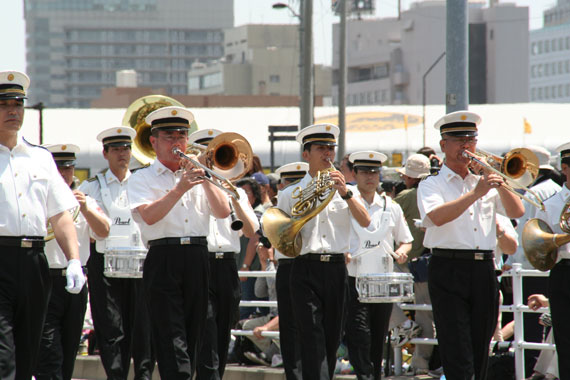
A picture of what I believe is the same police band I saw today, snatched from Google Images.
Anyway, I Wikipedia'ed (sp?) "Police Band" in English, and I was directed to the page describing the English rock trio formed in 1977. If you happen to read Japanese, check out the Japanese Wikipedia's article on police bands (the kanji for which are the title of this post, read けいさつおんがくたい keisatu-ongakutai). So I'm guessing that we don't have these things in the Anglosphere? Anyway, I thought it was pretty neat. They had flyers of various sorts, and I think I took the kiddie version, probably because of the pictures. I can't really read it, but I think it's general safety tips or something.
I wish American police played such good concerts. Maybe people would buckle up more if they did?
Wednesday, June 17, 2009
First Pictures of Japan
I've been in Japan for two days now and am really loving it. I couldn't have asked for a better living situation. Check out the view from the little balcony outside my room:


Unfortunately, it was pretty gray out when I took those pictures, as you can tell. But Yokohama looks beautiful in its own way even then. Pretty sweet, huh?
That tall building in both pictures is the Landmark Tower, the tallest building in Japan. The IUC is just a couple of blocks behind it. I walked the route to the Pacifico Conference Center, where the IUC is located, yesterday with Tomoyo, my father's cousin and the mother of the Meiri family, and Kazuyuki, the son who is my age. Tomoyo timed the walk, and apparently it took 20-25 minutes, but it felt much faster than that to me, perhaps because everything here is eminently fascinating to me.
I don't know where to begin recounting all of the little discoveries that have marked my time here so far, so I'll just share one that came to mind when I wrote the word "fascinating." Yesterday, the three of us had lunch before walking to the Pacifico Center. Kazuaki (the father of the family) had picked up what he (correctly) thought was some nice bread the day I got here, and Tomoyo suggested that I have some of that for lunch. She pointed to the fridge and told me that peanut butter and jelly were to be found there. I made myself a peanut butter and jelly sandwich and started eating. A little bit later, Tomoyo looked at my food and was quite surprised to see that I had made a peanut butter AND jelly sandwich! She explained that in Japan, it's normal to have a peanut butter (ピーナッツ "piinattsu") sandwich or to have a jelly (ジャム "jyamu") sandwich, but to put the two together is, apparently, really quite something. I explained that it's highly traditional in the States, to which she replied, "びっくりしました!" (I'm surprised/amazed).
I had thought that I would be more inclined to post quite often on this blog before I arrived here, but I've had so much fun settling in here that I've had to make an effort. Perhaps once I'm in a routine, posting will come more naturally. For now, though, I am so enjoying immersion in Japan that removing myself to reflect seems almost a hindrance.
Tomorrow morning (Thursday), I have to be at the IUC at 9:45 for a placement test, interview, and orientation, so I'm off to bed now. I'm quite tired from spending hours studying kanji in preparation for the placement test. So although it's morning at my home base, I'll sign off with "お休みなさい" (good night).
Monday, June 15, 2009
Safe Arrival!
Just a quick post to let you know that I have arrived safely in Yokohama. The trip was long, but I definitely think it was worth the effort! The relatives who are hosting me are very kind and welcoming, and I have a nice room (pictures to come later).
P.S. Jet lag hasn't really hit yet, probably because I slept for a few hours on the plane. It's just before 10 pm here. I think I might be actually accomplishing my goal of not getting jet-lagged at all (knock on wood)!
Sunday, June 14, 2009
Almost There!
Leaving the house in just over six hours now (hopefully) ... everything is packed, and I couldn't be more excited!
Thursday, June 11, 2009
T Minus 3 Days
Hello, readers!
I figured I would break the silence and write another pre-departure post, this one to catch you up on what I have been doing recently and to provide more details on my travel.
I am leaving the house early on Sunday morning (we'll see if we make it out the door by 6:30 am) to fly from Reagan to O'Hare in Chicago, then from there to Narita (Tokyo's international airport). The local time in Japan when I land will be 3:00 pm on the next day, Monday 15th June. Of course, that will feel like 2:00 am to me, since Japan is 13 hours ahead of the East Coast in the summer. Stay posted to see how I deal with more jet-lag than I have ever faced before (the most having been a 5-hour difference in London, 2006).
Last week, I bought a 14-day Japan Rail Pass to use after my classes end at IUC on the 31st of July. The pass gives foreign tourists unlimited use of almost all Japan Railways (JR) trains for a set time period of 7, 14, or 21 days. Travelers must obtain an exchange order before leaving for Japan and then exchange it at one of the major train stations in Japan.
Today, I was a bit nervous about the fact that I had not given much thought to buying an electronic Japanese-English dictionary to use on my trip. The Light Fellowship guidebook recommends one. I asked my little brother if I could rent his Nintendo DS for the summer, since I had read that one can buy a Japanese-English dictionary program for the DS for much less money than a separate apparatus costs. However, he did not want to part with his DS and instead suggested that I see if an application was made for my iPod touch. Sure enough, I found ShinKanji, whose full version only costs $5.99 on the iTunes App Store. I just installed it, and everything seems to work! I think it has all the features I need, including kanji input by drawing with my finger on a grid on the touchscreen of my iPod.
I am notoriously prone to procrastination of packing for trips, but the effort begins in earnest tomorrow. We'll see how it goes.
Look for a couple more posts before I depart. I am getting more and more excited for the trip!
Tuesday, May 19, 2009
First Post!
This is the inaugural post on my blog dedicated to my Summer 2009 trip to Japan. Welcome! I do not have much to say in this post other than a bit of background and a broad overview of what I will be doing in the Land of the Rising Sun, so here goes.
My paternal grandmother is Japanese, and I have always had a keen interest in foreign languages. These two factors combined to make me very interested in studying Japanese from a fairly early age. However, the thought of studying Japanese was always a distant possibility, as I never knew when I would have the opportunity actually to take classes. Japanese was not offered in the secondary schools I attended, so I gained proficiency in French instead (if you end up enjoying this blog, please remember to make me blog again when I end up spending a long period of time in France, which I very much hope will happen soon after I graduate from Yale). When I arrived at Yale in August 2007, I decided to take the plunge, now that I finally had the opportunity, and take Japanese. I have studied it for all four of my semesters at Yale.
This summer, I will be studying at the Stanford-run Inter-University Center for Japanese Language Studies (IUC) in Yokohama, Japan. I am leaving my home near Washington, DC, on 14th June, and I will return to the States on 11th August. The classes at IUC run from Monday 22nd June to Friday 31st July (six weeks). I purposely booked my flights so that I will have a week before my classes start to get settled in and a week and a half after they end to travel throughout Japan.
Before I close, I have two requests to make of you, my esteemed reader. First, a note on the title of this blog, which is currently "Gabriel Ellsworth の日本への旅" (make sure your browser's text encoding supports Japanese characters if some of that looks like gibberish). The title means "Gabriel Ellsworth's Trip to Japan" in, you guessed it, Japanese. I'll likely want to change it to something more creative, which is where you might play in: I will be taking suggestions. Second, I would also appreciate tips from you, especially if you have been to Japan before (but even if you have not), on places that I should plan to visit while I am there, as I am soon going to start developing my list of "must-visit" sites in earnest.
With that, I'll sign off for now. Welcome to my blog, and thank you for reading!
Subscribe to:
Posts (Atom)